Low back pain is the single leading cause of disability worldwide. The Global Burden of Disease study, published in The Lancet, reports that over 600 million people are affected at any given time. For most, the experience is cyclical: pain appears, they rest or take medication, the pain subsides, they return to activity, and it returns. The cycle continues because the underlying pattern — how the body stabilises (or fails to stabilise) the lumbar spine — hasn't changed. This is precisely the pattern that classical Pilates was designed to address.
Joseph Pilates' Approach to Pain
Joseph Pilates himself worked extensively with people in pain. In his New York studio, alongside professional dancers, he trained clients recovering from injuries, surgeries, and chronic conditions. His approach was consistent: don't treat the symptom, retrain the system. Strengthen the deep musculature that supports the spine. Restore range of motion where it's been lost. Build endurance, not just strength, so the body can sustain correct posture through the demands of daily life. As he wrote in Return to Life Through Contrology (1945), the goal was never isolated muscle strengthening but 'the attainment and maintenance of a uniformly developed body with a sound mind.'
What the Evidence Shows
The modern evidence supports this approach. A landmark 2015 Cochrane systematic review by Yamato and colleagues examined 10 randomised controlled trials involving over 500 participants and concluded that Pilates reduces low back pain intensity and disability more effectively than minimal intervention. Miyamoto et al. (2018), in the British Journal of Sports Medicine, further examined dosage and found that two sessions per week produced meaningful clinical improvement in chronic low back pain patients. A separate systematic review by Lin et al. (2016) in the Journal of Physical Therapy Science confirmed these findings, noting improvements in pain, disability and quality of life across multiple trial designs.
"When a new client comes to me with back pain, the first thing I tell them is: we're not going to 'fix' your back. We're going to retrain your whole body so your back doesn't have to compensate any more. That shift in understanding changes everything." — Katie Kollar
Training the Deep Stabilisers
What makes Pilates particularly effective for the spine is the way it trains the deep stabilising muscles — specifically the transversus abdominis, the multifidus, and the pelvic floor. These muscles don't produce large, visible movements. They produce the low-level, continuous contraction that keeps the vertebrae aligned during everything from sitting at a desk to bending to lift a child. Landmark research by Hodges and Richardson (1996) at the University of Queensland showed that in people with low back pain, the transversus abdominis activates late — it fires after the movement has started, rather than in the anticipatory window before it. Pilates retrains this timing. Through exercises that demand powerhouse engagement before limb movement, the nervous system re-learns to stabilise first and move second. Understanding the six principles — particularly centering and control — is key to grasping why this works.
Assessment First, Always
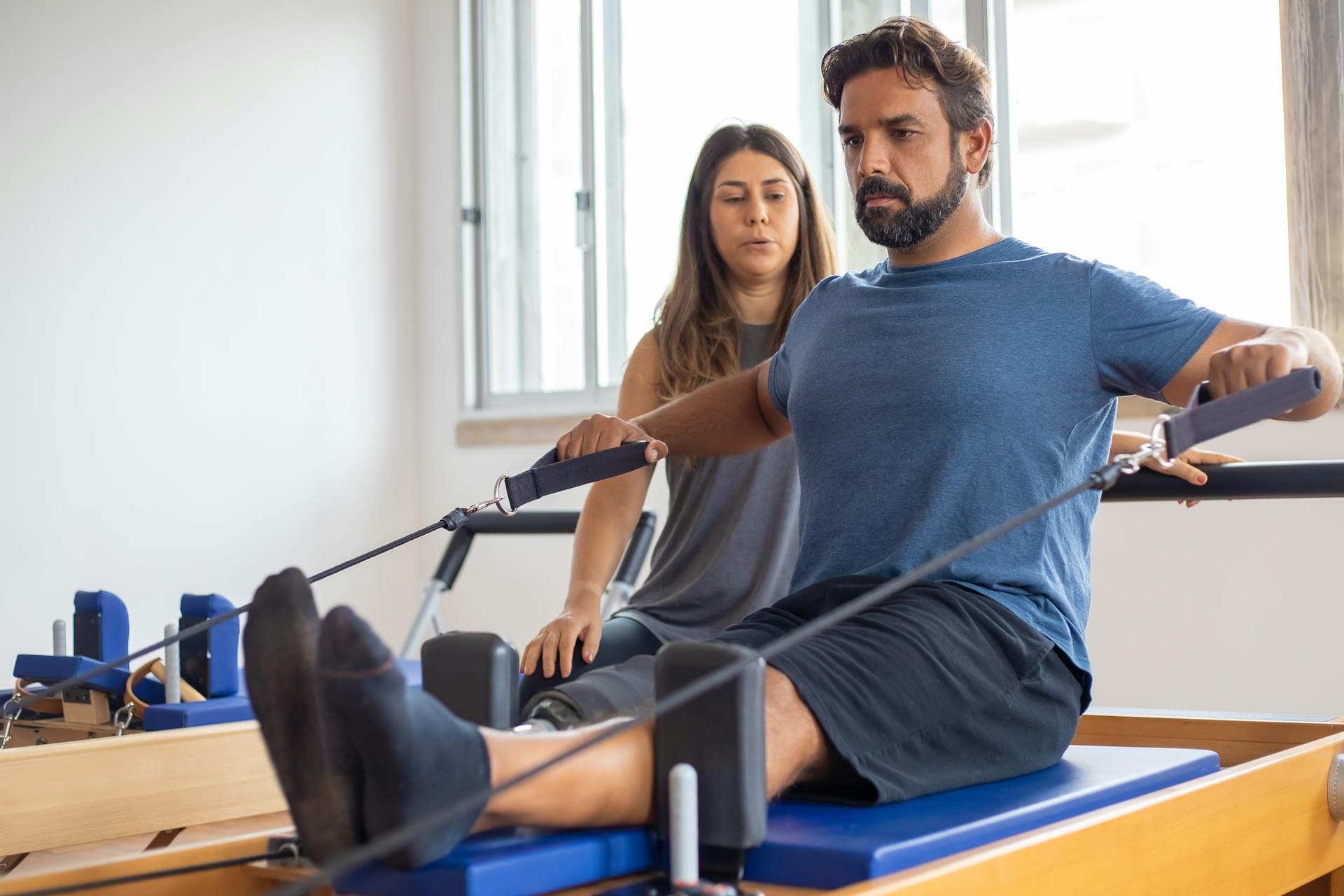
In a classical studio, the work begins with a thorough assessment — always. Where is the pain? When does it appear? What movement patterns provoke it? Does the client have imaging (MRI, X-ray) and medical clearance? This information shapes the training plan from the first session. A client with a disc herniation at L4–L5 will follow a different programme than a client with facet joint arthritis at L3–L4, even though both present with 'low back pain.' This level of individualisation is why we recommend starting with a private session — and it's possible because classical Pilates was designed for small groups and private instruction, not lecture-hall-sized classes.
"I always ask for a medical history and, if possible, imaging before we start. A disc herniation and facet arthritis both cause back pain, but they need completely different approaches on the apparatus. You can't treat what you don't understand." — Katie Kollar
The Cadillac: Spine-Specific Rehabilitation
The apparatus plays a central role in spinal rehabilitation. The Cadillac — Joseph Pilates' most versatile creation — allows the teacher to position the client supine, prone, seated or standing while working with spring resistance overhead, underfoot, or from the side. The Roll-Down Bar series on the Cadillac gently articulates the spine through flexion under controlled tension, decompressing the vertebrae without the load-bearing demands of a standing forward bend. The Leg Spring series strengthens the hip stabilisers and deep core while the spine remains fully supported on the table. For clients who can't yet hold a neutral spine during mat work, the Cadillac provides an intermediate step that lets them build strength and proprioception safely. You can see the full apparatus suite when you visit our studio.
The Reformer: Closed-Chain Retraining
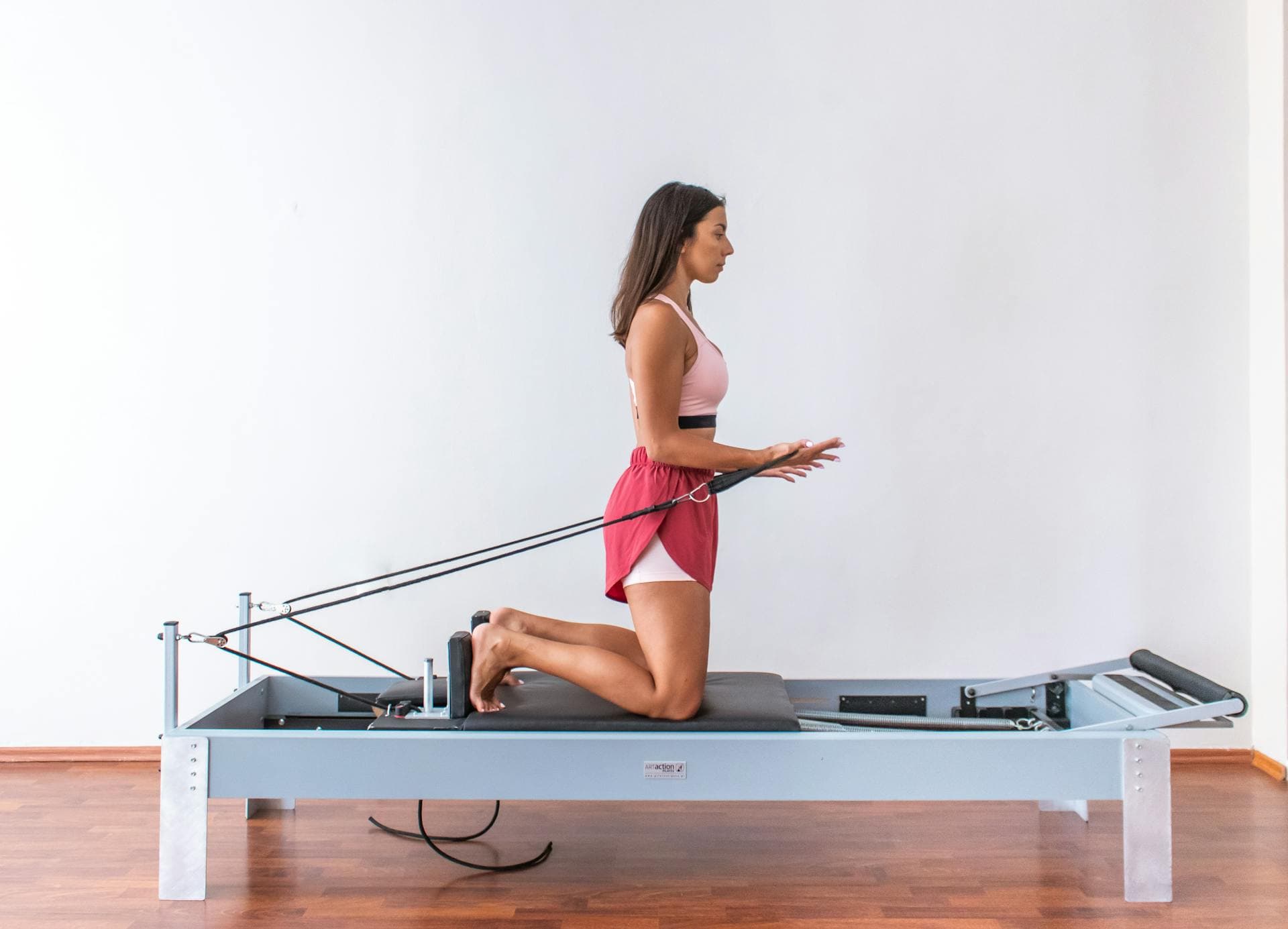
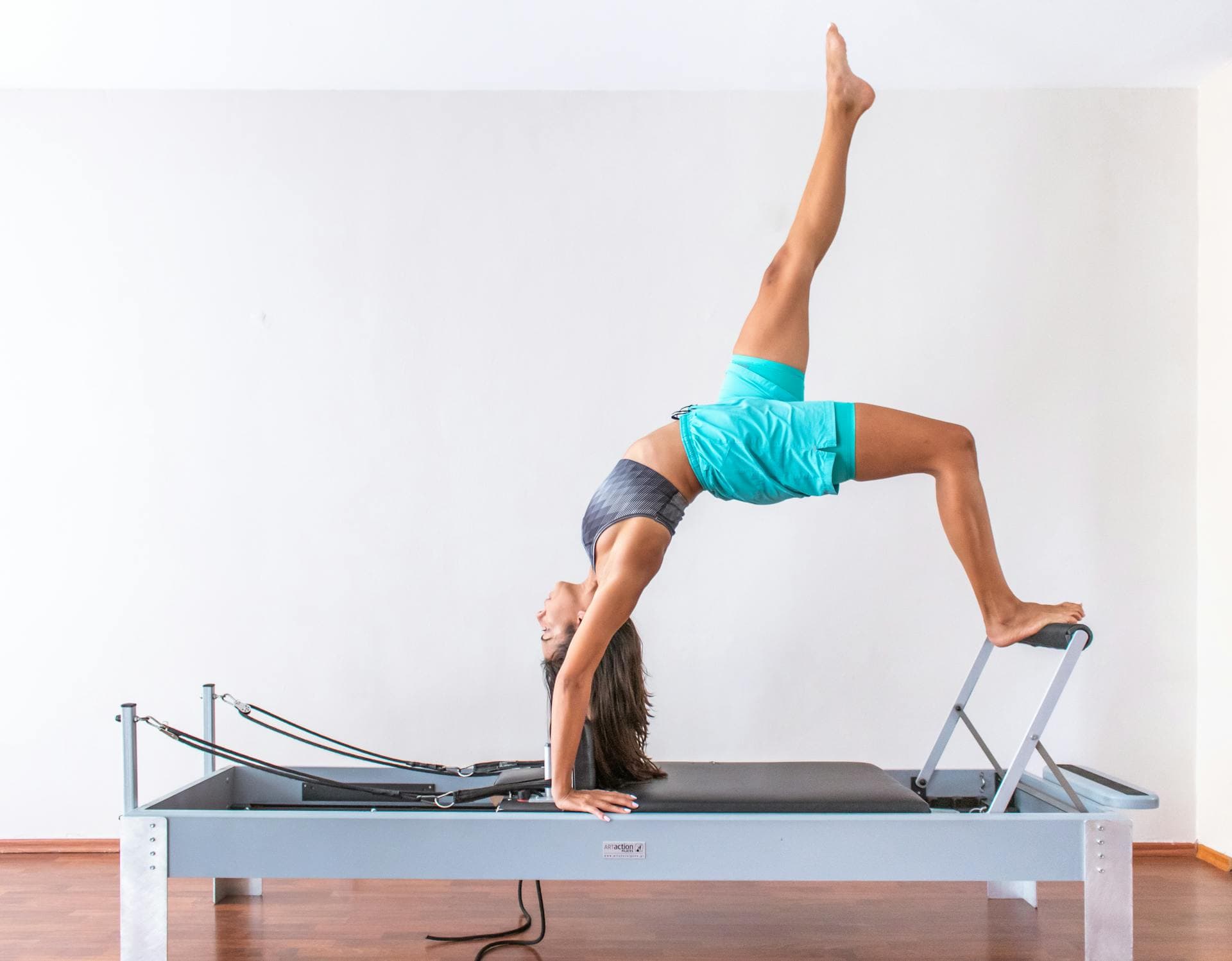
The Reformer extends this work by adding closed-chain movement. The Footwork series — the first exercise on the Reformer in the classical order — trains lower extremity alignment and pelvic stability against spring resistance. For a back pain client, this is foundational: if the feet, knees, and hips don't track correctly during basic leg press movements, they won't track correctly during walking, climbing stairs, or standing from a chair. The Reformer makes these alignment patterns visible and repeatable. Later exercises like the Short Spine Massage use the machine's straps and springs to take the spine through flexion and extension in a traction-like environment — a movement that many back pain clients describe as the single most relieving exercise they've experienced.
The Wunda Chair: Bridging to Daily Life
The Wunda Chair brings a different challenge. Its small footprint and heavy spring resistance demand exceptional core stability in positions that closely resemble daily functional movements — stepping up, pressing down, sitting to standing. For a back pain client in the later stages of rehabilitation, the Chair bridges the gap between the supported environment of the Reformer and the unsupported demands of real life. The Going Up Front exercise, for instance, requires stepping onto the Chair's pedal and rising to standing on the small seat — a direct analogue to climbing stairs or stepping onto a kerb, but with spring resistance that exposes any stabilisation deficit instantly.
When Pilates Isn't the Starting Point
There are situations where Pilates is not the right starting point. Acute disc herniations with radiculopathy (nerve-related leg pain), spinal fractures, and post-surgical patients within the first weeks of recovery typically need medical management first. A qualified classical instructor will recognise these red flags and refer the client to a physician, physiotherapist, or specialist before beginning training. Once cleared, Pilates integrates seamlessly with ongoing medical care — many physiotherapists in Austria and Germany now recommend classical Pilates as a follow-up to their own treatment protocols. Check our FAQ for common questions about medical conditions and Pilates.
Progressive, Not Conservative
What distinguishes the classical approach from a generic 'core-strengthening' programme is the progression. You don't start with advanced exercises and modify them downward — you start simply and build upward. A new back pain client might spend the first four to six sessions working exclusively on the Reformer and Cadillac, learning the Hundred in a modified position, finding their powerhouse through the Leg Spring series, and restoring basic spinal articulation with the Roll-Down Bar. Only when these foundational patterns are established do mat exercises and more complex apparatus work enter the programme. This progressive structure is not conservative — it's intelligent. It ensures that each new challenge is built on a foundation that can support it. Our levels system reflects this exact philosophy.
The Psychological Dimension
The psychological dimension matters too. Chronic back pain reshapes how people relate to their bodies. After months or years of pain, many clients develop movement avoidance — a subconscious fear of bending, twisting, or loading the spine. This fear leads to deconditioning, which in turn reinforces the pain. The controlled environment of a Pilates studio — springs that assist, a teacher who watches every movement, a system that progresses at the body's pace — provides a safe space to rebuild trust. Clients begin to discover that their spine can move, can bear load, can flex and extend without catastrophe. This shift in belief is often as important as the physical strengthening.
"Some of my back pain clients arrive afraid to bend forward. Within a few weeks on the Cadillac, they're articulating their spine through a full Roll-Down and smiling. That moment — when they realise their body can do more than they believed — is why I do this work." — Katie Kollar
Consistency Over Intensity
Consistency matters more than intensity. Miyamoto et al. (2018) found that two to three sessions per week produced clinically significant improvement, and the Cochrane review by Yamato et al. (2015) reported maintenance of benefits months after training ended. A single session won't fix anything. A single month might not either. But a committed programme — with qualified instruction, apparatus-based work, and progressive challenge — reliably produces measurable improvements in pain, function, and quality of life. This isn't a promise from a marketing brochure. It's what the peer-reviewed research consistently shows. See our pricing and packages to plan a programme that fits your schedule.
Joseph Pilates didn't design his method for athletes. He designed it for anyone willing to take their body seriously. For the millions of people living with back pain, that willingness — combined with a scientifically supported system and a teacher who knows how to apply it — can be the beginning of genuine, lasting change. Read about the results our clients have achieved.